

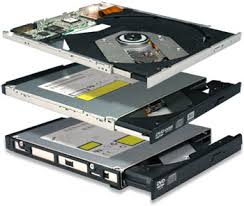

In computing, an optical disc drive (ODD) is a disk drive that uses laser light or electromagnetic waves near the light spectrumoptical discs. Some drives can only read from discs, but recent drives are commonly both readers and recorders. Recorders are sometimes called burners or writers. Compact discs, DVDs and Blu-ray discs are common types of optical media which can be read and recorded by such drives. as part of the process of reading or writing data to or from
Optical drives retreive and/or store data on optical discs like CDs and DVDs which hold much more information than classic portable media options like the floppy disk.
The Optical Disc Drive is Also Known As:optical drive, CD drive, DVD drive, disc drive
Most optical drives can play and/or record onto a large number of different disc formats. Popular formats include CD-ROM, CD-R, CD-RW, DVD, DVD-RAM, DVD-R, DVD+R, DVD-RW, DVD+RW, DVD-R DL and DVD+R DL. Reference your optical drive's manual before purchasing media for your drive to avoid incompatibility issues.
The most important part of an optical disc drive is an optical path, placed in a pickup headPUH),[1] usually consisting of semiconductor laser, a lens for guiding the laser beam, and photodiodes detecting the light reflection from disc's surface. (
The back end of the optical drive contains a port for a cable that connects to the motherboard. The type of cable used will depend on the type of drive but is almost always included with an optical drive purchase. Also here is a connection for power from the power supply.
Most optical drives also have jumper settings on the back end that define how the motherboard is to recognize the drive when more than one is present. These settings vary from drive to drive so check with your optical drive manufacturer for details.
Rotational mechanism
Optical drives' rotational mechanism differs considerably from hard disk drives', in that the latter keep a constant angular velocity (CAV), in other words a constant number of revolutions per minute (RPM). With CAV, a higher throughput is generally achievable at an outer disc area, as compared to inner area.
Loading mechanisms
Current optical drives use either a tray-loading mechanism, where the disc is loaded onto a motorised or manually operated tray, or a slot-loading mechanism, where the disc is slid into a slot and drawn in by motorised rollers. Slot-loading drives have the disadvantage that they cannot usually accept the smaller 80 mm discs or any non-standard sizes; however, the Wii video game console seems to have defeated this problem, for it is able to load standard size DVDs and 80 mm GameCube discs in the same slot-loading drive.
Recording performance
Optical recorder drives are often marked with three different speed ratings. In these cases, the first speed is for write-once (R) operations, second for re-write (RW or RE) operations, and one for read-only (ROM) operations. For example a 12x/10x/32x CD drive is capable of writing to CD-R discs at 12x speed (1.76 MB/s), write to CD-RW discs at 10x speed (1.46 MB/s), and read from any CD discs at 32x speed (4.69 MB/s).


Tidak ada komentar:
Posting Komentar